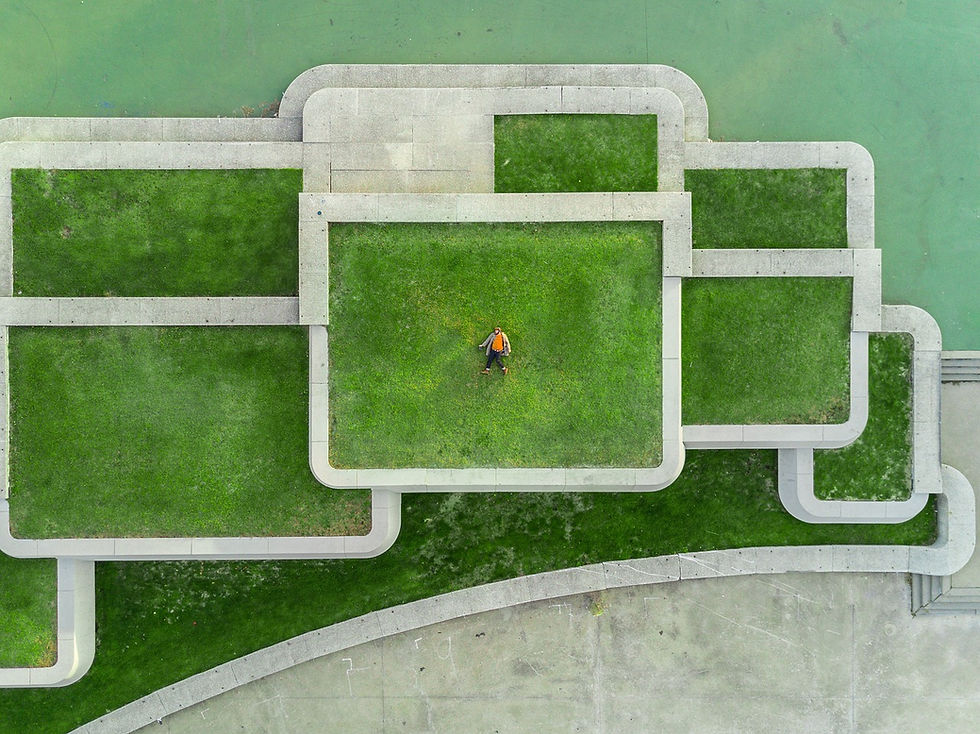
Green Artillery: How could railroads turn into humanistic green corridors?


Photo credit: Rockwell Branding Agency
Railroads are essential and indispensable modes of transportation in modern cities. These superstructures physically, socially, and economically connect various neighborhoods. However, these massive structures do not typically include appealing places where people want to spend their time in daily life. Recently, this trend has begun to change, driven by initiatives aimed at addressing the challenges posed by the physical barriers created by railroads. By focusing on human-scale elements of these enormous metal structures, such as the components of railroads, and improving their accessibility, railroad areas may improve their attractiveness.
Railways run through various neighborhoods within the city, creating physical, social, and economic connections between them. Due to their powerful qualities—such as urban-scale connectivity, uninterrupted mobility, and constant dynamism—railroads are invaluable as the foundation of contemporary cities. They consist of a collection of systems that include infrastructure and communication. It is time to build modern cities on reliable, dynamic, and adaptive systems.
The article will assess two concrete examples, one from the past and one from the future. The case of Barcelona provides fundamental knowledge about artilleries (refering to streets in urban structure) and why they are vital for healthy urban planning. The case of Milan enlightens us on how transforming existing railway corridors (which can also be considered artilleries in modern cities) into green promenades, parks and recreational areas that make a city more breathable.
Barcelona adopted the philosophy of “the system” while constructing its most captivating urban blocks. Spanish urban planner and civil Ildefons Cerdà, who worked on the plan of Barcelona’s urban expansion, envisioned a homogeneous and egalitarian urban structure. He did not focus on built-up areas; instead, he prioritized systems made up of trees, infrastructure, sewage, and recreational spaces. Railroads, as “infrastructural systems”, have significant potential to serve as the backbone for the future blocks envisioned by Cerdà. Barcelona's successful urban planning can be attributed to its democratic infrastructural system, which divides the city into uniform parcels, allowing each block to have equal opportunities and functional uses. This approach could be applied to contemporary cities in the future. Since rail corridors divide the city into large parcels, each dedicated to different neighborhoods, providing equal opportunities through these corridors could enhance the livability standards of these areas. In this way, the railway network can transform from creating negative spaces that people tend to avoid into a system that works in harmony with nature, forming alternative grounds for democratic public spaces at the heart of the city.
Photo credit: Rockwell Branding Agency, Public Domain image Museu d'Historia de la Ciutat, Barcelona
There is an initiative in Milan aimed at realizing an ambitious transformation plan called “Scali Ferroviari“ masterplanned by Stefano Boeri Architetti. This project seeks to redevelop disused railway yards and create new urban districts along the old rail network. The proposal envisions transforming the old railyard network into green corridors featuring new recreational spaces, which will enhance the city’s overall well-being offer. This green artillery will include mixed-use buildings, residential programs, and parks in areas such as Farini, Greco, Lambrate, Porta Romana, Rogoredo, Porta Genova, and San Cristoforo. These buffer zones are intended to function as so-called urban ecotones, where diverse ecosystems can interact and thrive. The project aims not only to establish a “Green River”, which is the name of the project, throughout the city, but also to promote social inclusiveness within socially diverse neighbourhoods. Each district will be designed by a different architectural team, with each area dedicated to specific functions. Furthermore, 65% of the total redevelopment area will be dedicated to green areas according to planning. While 30% of the areas will be utilized for social and subsidised housing, 32% of the total volume will be allocated to non-residential purposes like offices, retail, etc.

Photo credit: Francesco Ungaro
Each railway station area will be allocated for distinct functions:
-San Cristoforo: A natural oasis
-Porta Genova: Fashion and design
-Farini: Unitary park
-Greco and Lambrate: University-related activities
-Porta Romana: Innovative agriculture
-Rogoredo: Prevalence of housing
From that point of view, the case of Milan provides reliable data to evaluate how cities could be built on existing systems, and how the infrastructural system turns into “eco-systems”. The conception could go even further and beyond merely turning railroads into green promenades, and encourage people to spend their valuable time on artificial grounds such as elevated railroads and bridges. This opens up new possibilities, perspectives, and ways of building. As Cerdà imagined, the cities could be “liberated”.
As Cerdà imagined, the cities could be “liberated”.
Sources:
Pallares-Barbera, Montserrat, Anna Badia, and Jordi Duch. “Cerdà and Barcelona: The Need for a New City and Service Provision.” Urbani Izziv 22, no. 2 (2011): 122–36. https://doi.org/10.5379/urbani-izziv-en-2011-22-02-005
Sala, Beppe. 2017. “Scali Ferroviari, si fa sul serio! Siglato l’Accordo per la riqualificazione degli Scali Ferroviari. Un breve vademecum per orientarsi.”
IngegneriaMilano, June 24, 2017. https://www.ingegneriamilano.com/2017/06/24/scali-ferroviari-vademecum/
La Repubblica. 2016. “Milano, il sogno di un ‘fiume verde’ tra gli scali ferroviari.” La Repubblica (Milano), May 12, 2016.
https://milano.repubblica.it/cronaca/2016/05/12/foto/fiume_verde_boeri_milano_scali_ferroviari-139651762/1/.
Ortega, Lluís, and Julia Capomaggi. 2025. “Leading by Eixample: Barcelona, Spain.”
The Architectural Review, February. Scalo di Porta Romana. “Lo Scalo.” Accessed August 18, 2025. Scalo di Porta Romana. https://scaloportaromana.com/lo-scalo.
Bausells, Marta. 2016. “Story of Cities #13: Barcelona’s Unloved Planner Invents Science of ‘Urbanisation’.” The Guardian, April 1, 2016.